

Today’s roller coaster landscape is becoming increasingly international. With the rise of streaming video, social media, and even Google Translate the coaster enthusiast community and industry is more connected than it’s ever been. With the recent rise of Chinese theme parks and Chinese ride manufacturers it’s easy to forget a time when Japan seemed second only to the United States as a thrill ride destination. The undisputed king of the Japanese coaster manufacturers was “Toyo Goraku Ki Kabushiki Kaisha” or TOGO. TOGO opened their first roller coaster in 1953 at Hanayashiki park in Tokyo and soon began building rides all over Japan. In 1983 their stand-up coaster model was opening at Kings Island as King Cobra, bringing TOGO to North America. Over the next two decades TOGO would try to capitalize on this success and expand into the American and European market. They eventually opened a subsidiary named TOGO International headquartered in Middletown, Ohio. While there was some success an ill-fated 1997 project at Knott’s Berry Farm would mark the end of TOGO’s presence as a leader in the coaster world.
– In the past, many of our images have been posted, featured, and shared on forums, social media platforms and websites around the web. We work hard to provide the coverage that we do, and we encourage our audience to share our content and use our images, BUT ONLY IF proper credit is given to thecoasterkings.com. Thank you! –
This article aligns with a special podcast mini-episode! Click the logo below to listen to the podcast!

Knott’s Berry Farm has had a longstanding presence dating back to the 1920s. The 1975 addition of Corkscrew, which I discussed in part 1 (link) of this series, brought Knott’s to the forefront of the thrill world. The Knott’s family continued the thrill additions the following year, opening Motor Cycle Chase in 1976. Also located in the park’s Roaring 20’s area, this four-track Arrow Development steeplechase coaster featured motorcycle themed trains that raced around a single rail course. Due to safety concerns, Motor Cycle Chase would be modified to utilize tub-like single cars and lower it’s maximum speed and height. The re-themed Wacky Soap Box Racers opened for the 1980 season with a cartoon soapbox-car racing theme. This attraction proved very popular with families and children. In 1990 Corkscrew was replaced with Boomerang and the area’s 1920s theme became less cohesive. The Roaring ’20s needed revitalization. Multiple themes were proposed, but an extreme-sports surf theme was applied and the area was re-christened The Boardwalk for 1996. Wacky Soapbox Racers didn’t fit this new area and plans were already in place to replace it with a major thrill ride.

Knott’s has long fallen in a weird place in the thrill market. Not as family and theme oriented at nearby Disneyland but also far from the thrill capital that Magic Mountain purported to be. The Knott’s family chose to lean into this in between space for much of the park’s history, the most prominent example being the large-scale but family focused Zierer coaster Jaguar!. For their next major addition they decided to continue in this vein while keeping the popular racing element of Wacky Soapbox Racers. Knott’s envisioned a large-scale racing coaster that would provide thrills that the whole family could enjoy. Knott’s required a creative and compact layout due to space constraints. Knott’s presented the proposed layout to multiple coaster manufacturers. TOGO won the contract, this compact looping layout seemed perfectly in line with a series of looping wild-mouse coasters the company had been building in Japan since the 1980s.
Windjammer Surf Racers opened in 1997, expanding The Boardwalk with a lagoon and several other beach-theme elements. The ride consisted of a red and yellow track which climbed a side-by-side chainlift, reaching a maximum height of 69 ft (21 m), before taking a right hand turn into a vertical drop where the ride reached it’s maximum speed of 40 mph (64 km/hr). Side by side vertical loops followed this drop before the tracks split into a series of turns and small dips. The finale of the ride saw both tracks rejoin for a helix around a structure designed to provide a tornado like effect to riders. Knott’s heavily marketed the ride as the world’s first major outdoor dual-tracked steel looping coaster. On paper it seemed the perfect family attraction, providing a family friendly looping coaster experience absent from the park since Corkscrew’s departure.

The public’s reaction was mixed, it didn’t fulfill the promise of a major thrill ride and it’s meandering layout provided little thrills. The ride was also noticeably uncomfortable with both the tracking and the train’s oversized shoulder harnesses contributing. It was quickly determined that much of the ride’s track was misaligned requiring significant modifications. Knott’s discovered another, more-embarrassing, flaw. TOGO had designed and manufactured the attraction to complete the course, but only without any significant wind resistance. This resulted in the trains sometimes unable to complete the course with winds as low as 3 mph(4.28 kph). The wind literally jammed Windjammer. These mechanical issues resulted in significant downtime and reduced capacity as oftentimes only one side of Windjammer was operational.
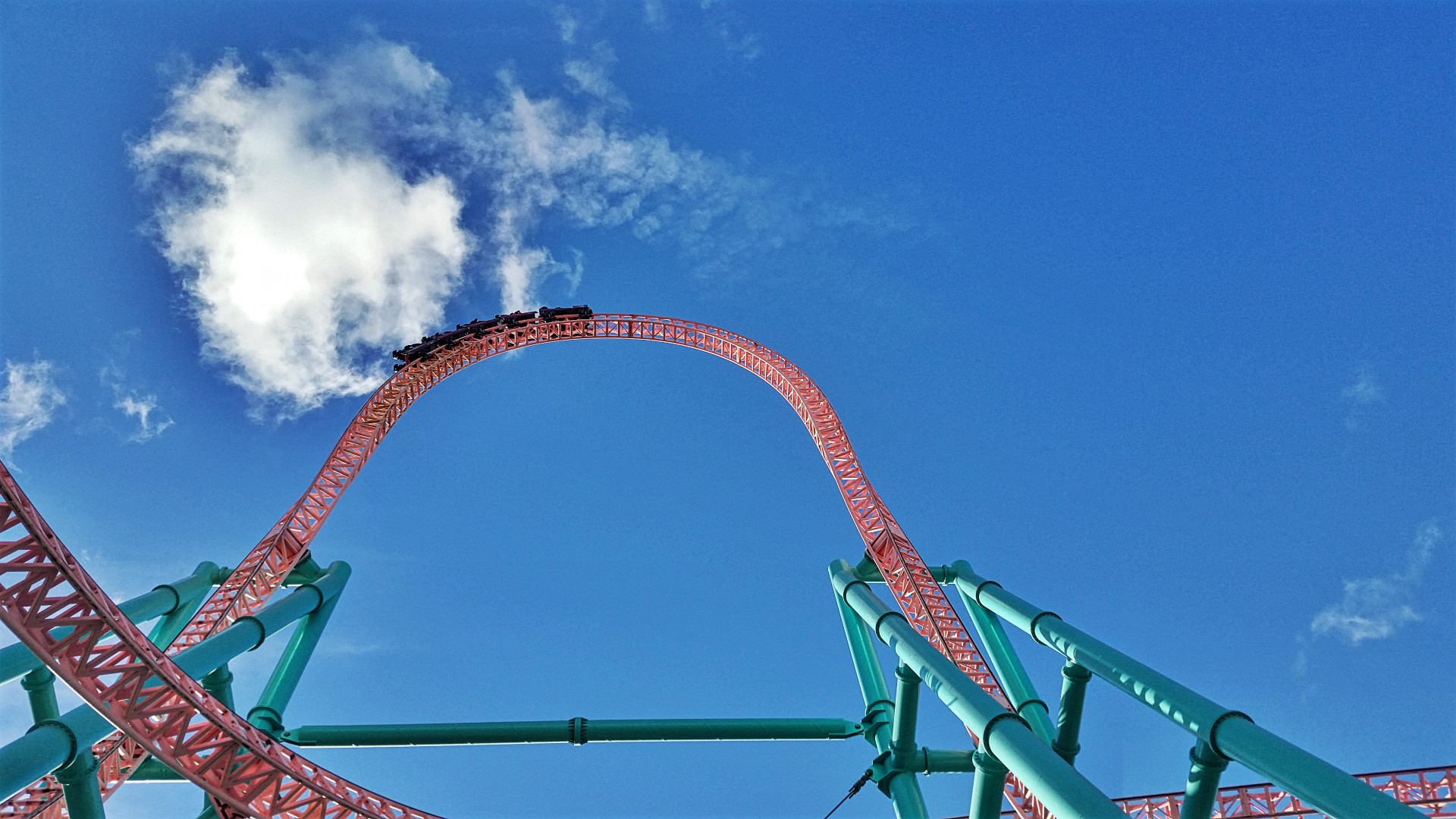
The same year that Windjammer opened the Knott’s family made the decision to sell the park to Cedar Fair Entertainment Company for $300 million. It’s worth noting that this was prior to the Paramount Parks acquisition and Cedar Fair was far from the theme park giant they are today. The new management immediately saw Windjammer as a problem. In 2000 Knott’s Berry Farm filed a lawsuit against TOGO suing for $17 million in damages. The park seemed actively embarrassed by the attraction. General manager Jack Falfas said that “Windjammer is not a ride I want running in the park.” (LA Times) While the legal proceedings continued TOGO International filed for bankruptcy in 2001. That same year Knott’s moved forward with demolishing Windjammer and constructing the groundbreaking Xcelerator, a 205 ft(62 m) Intamin accelerator coaster, in its place. In 2003 the jury would eventually reject Knott’s lawsuit in favor of TOGO International. It is unclear if this decision was motivated by Knott’s quick replacement of the ride. The damage was done, TOGO ceased manufacture and sales of rides in North America and downsized considerably in Japan. TOGO built their last roller coaster for Tokyo Disney Sea’s 2001 opening. The world lost the first Asian coaster-manufacturer to gain international recognition.
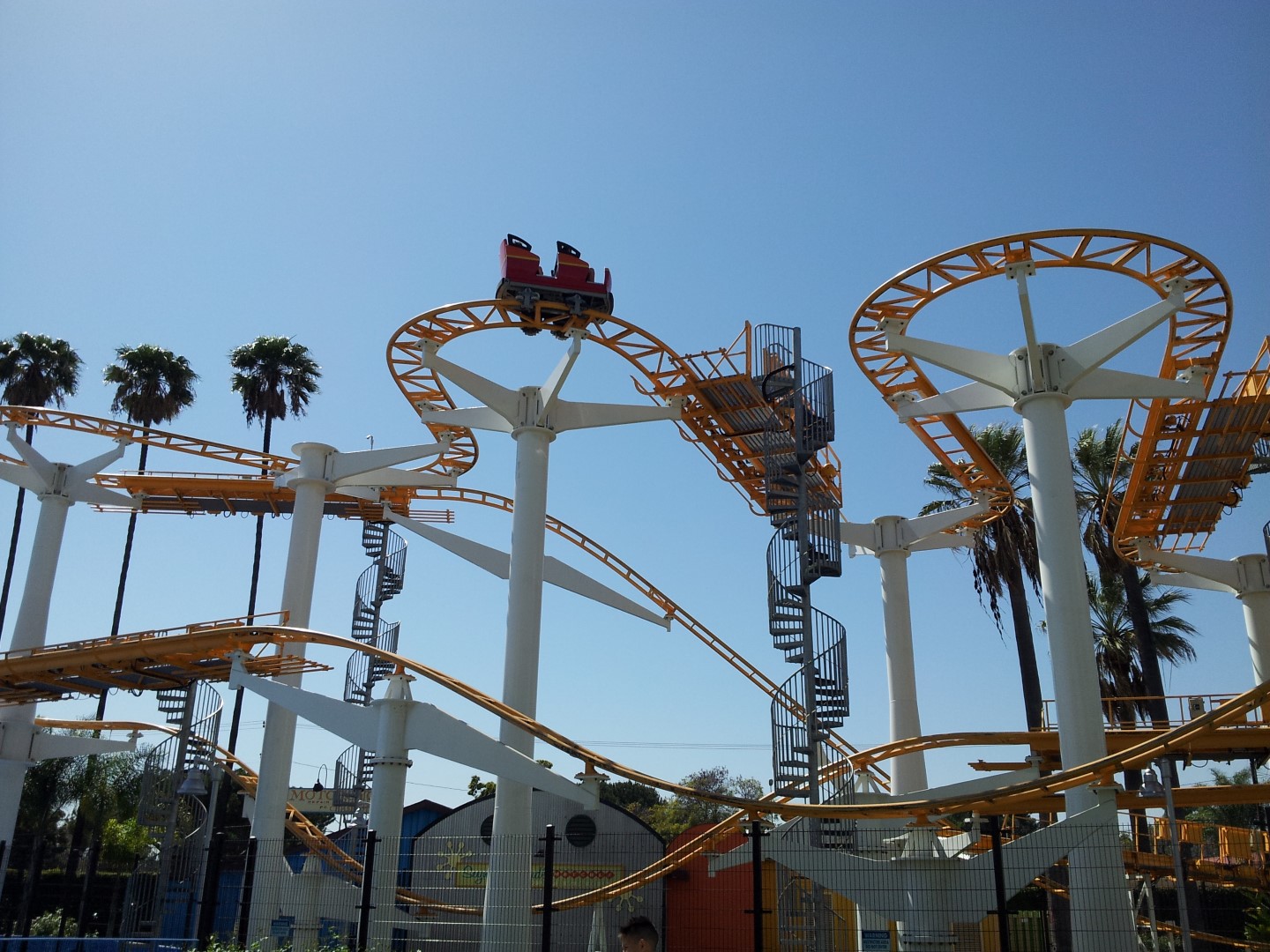
The indisputable failure of Windjammer represents an important turning point in Knott’s Berry Farm history. It’s concept represented the ideas of family friendly thrills that the Knott’s family management had seen as the core of the business. Cedar Fair’s large scale additions starting with 1999’s wooden coaster GhostRider took the park in a specifically thrill direction. It’s possible they were over-correcting. In the past 10 years Cedar Fair management has done significant work to fill in the park’s family offerings. The 2013 Mack Wild Mouse, Coaster Rider, seems to live as a spiritual successor to the ill-fated Windjammer, replacing one of Cedar Fair’s ambitious thrill additions, Perilous Plunge, with a family friendly mid-size coaster. Windjammer remains one of the oddest pieces of coaster history and continues to raise the question of what makes a successful signature coaster.
After 4 weeks in Southern California it’s time to take a drive up i-5 back to Santa Clara. Next week’s subject is a production model that proved far less successful than the coaster that inspired it. Join me as we discuss Paramount Great America’s ambitious move to become the first park with two inverted coasters less than 10 years after the concept was introduced.

Windjammer did not have vertical drops as stated above.